Asslam o Alaikum, My honourable Sir, As scholars advise, " Solitude is where you meet yourself" But whenever I sit to reflect on my own presence, rather than meeting myself, I feel I lose myself. Everything around me including myself becomes question mark and 'I' itself feels strange. I feel void. Sir, what's that...? Am I missing something in what scholars meant or is this beyond my understanding? I believe your understanding more than my confusion 😊 Reply to the question: Wa Alaikum Assalam What you’re describing actually makes a lot of mixed sense—and it’s more common (and more meaningful) than it feels in the moment. When scholars say “Solitude is where you meet yourself,” they’re not talking about an immediate, peaceful, clear “meeting.” That line is often quoted in the spirit of thinkers like Rumi or Al-Ghazali—but the first stage of solitude is usually not clarity. it shows confusion. What you’re experiencing—the feeling of: losing yourself, everyth...
Get link
Facebook
X
Pinterest
Email
Other Apps
Six Basic Rules in English
Get link
Facebook
X
Pinterest
Email
Other Apps
-
Any language can be learnt if one is willing to do hard work, the same is with the English language. There are millions of people who live on this Earth. They speak different languages. These languages are different from one another pertaining to their scripts, diction and dialects. But English is a very easy language as compared to other well-known languages, such as French, German and Arabic.
After teaching English for a long time, I have got Six Basic Rules to use correct forms of verbs which every learner of the English language must know. After this, he can improve a lot, and there is no limit to the learning of this language.
When the students have learnt about two parts of speech: Noun ( a naming word) and Verb ( the action of the Noun), they must learn the following SIX BASIC RULES to learn English.
(DC)
NOUN
A Noun can be a singular, such as a book, a tree, a man, a girl, a woman, a man, a child etc
A Noun can be plural, such as books, trees, men, girls, women, children etc
VERB
A Verb can be a singular, such as goes, has, was, is, writes, sings etc
A Verb can be plural, such as go, have, were, are, write, sing etc.
1. A Singular Noun takes a singular verb,(goes, walks, has, is, was) in
Subject + verb + object
Example:
He solves all the questions
It rains a lot in summer.
A boy wants to play games.
And a Plural Noun takes a plural verb ( go, walk, have, )
Good Morning! My respected Sir, I pray this finds you under the shade of Allah's mercy and protection. As my mentor in spirit ❤️, I have been reflecting on the nature of expression lately, and a question arose that I felt you could help me navigate: Who is a true poet? And what is the essence of poetry? ( in your context). I often find that when we read verses without personal experience or reflection, they feel like a hollow echo of imagination. Yet, when li?fe aligns with those words, they begin to murmur depths that lead to unfathomable philosophy. They carry emotions so delicate that they can make the reader weep or smile at once. Does it depend upon the reader on how he perceives, or the writer on how he delivers? I would be deeply honoured to listen to your thoughts on this when time permits 😊. Use of EENNO SANAM and FAMILY Reply to this message: 'Life is like a dome of many coloured glasses, as Percy Bysshe Shelley beautifully suggests. To me, Allah has created a vas...
Name Personality Test: First Letter of Your Name Reveals Your True Personality Traits Read and give your comments about my assessment about your name. How much it corresponds to your personality. I love to hear and make the addition. What is the first letter of your name: A to Z? Name Personality Test : In another fascinating psychology test, we discover that the first letter of your name holds interesting secrets of your personality traits. Just like body parts can reveal your personality, your name also can reveal your true personality traits. In this name personality trait, we will explore your personality based on the first letter of your name. What is the first letter of your name? We have put together the personality traits of names. You are welcome to give your feedback. Thank you, Prof. Muhammad Masood Sadiq If your name starts with the letter A, your personality traits reveal you are ambitious, courageous, confident, and determined. You have a very pragmatic a...
Full Length Paper 1 for NMDCAT & NUMS 1. " Exculpate " A) Celebrate B) Declaration C) Exonerate D) Admiration ANSWER= (C) Exonerate Explanation: 'Excuplate' means to clear from alleged fault or guilt. Check Answer 3. " Predilection " means A) Pregmatic B) Vociforous C) Gleaned D) Natural Liking ANSWER= (D) Natural Liking Explanation:- Natural liking for something Check Answer 4. " Malleable " means A) Palpable B) mouldable C) Meliorate D) Inflexible ANSWER= (B) Mouldable Explain:- Capable of being shaped, altered, or controlled by outside forces or influences Check Answer 5. "Chagrin" A) Distress B) Pompous C) Essential D) Casual ANSWER= (A) Distress Explanation: a distress of mind caused by humilation, disappointment or faiulure Check Answer Choose the correct...
Chiromance People always used to be very curious about their future. Chiromance is an ancient method of predicting the future and interpretation of a person's personality from the pattern of the lines of their hands. Every hand has a set of different lines and patterns. Sometimes these lines can form even numbers and letters. One of these letters may be the letter M, the meaning of which has been researched by many mystics. As many believe, the lines on the palm reveal our character and destiny. The letter M is assigned to truly special people. They are endowed with extraordinary intuition and represent the ideal partners for any business. If the people you love have the special letter M inside the palm, you have to know that you can't joke around and you can't lie or cheat in any way to that person. By being highly intelligent and intuitive, people with the letter M in the palm of their hands can easily tell they're being lied to or fooled. Women who have the letter ...
Difference between Present Participle & Past Participle "Write" is a Simple Present Examples: He writes poems. He does not write poems. Does he write poems? Does he not write poems? "wrote" is Simple Past He wrote poems. He did not write the poems. Did he write the poems? Did he not write the poems? "written" is a Past Participle (the third form of the verb) He has written many poems. He has not written many poems. Has he written many poems? Has he not written the poems? "written" is Past Participle Adjective I have got many written poems. "writing" is a Present Participle He is writing many poems. They are looking for a "writing" board. "writing" is here an adjective (Present Participle Adjective) and "looking" is a Present Participle Practice Test for Participles 1. She is writing a novel these days. "writing" is A) Past Participle B) Present Participle ANSWER= (B) ...
Correct Use of Adverb (very, too, much, & many) Use of sequence of sentences in English 1. She is a ___ beautiful lady. A) much B) very C) too D) too much ANSWER= (B) very Explanation: She is a very beautiful lady.. Check Answer 2. She is ___ happier today. A) many B) very C) much D ) None of them ANSWER= (C) much Explanation: She is much happier. Check Answer 3. He was ___ surprised at me. A) so B) too C) much D) very ANSWER= (D) very Explanation: He was very surprised at me . Check Answer 5. The dog runs ____ . A) very fastly B) fasting C) fastly D) fast ANSWER= (D) fast Explanation: My dog runs fast. Check Answer 6. She is as wise as both of ____. A) we B) our C) us D) ours ANSWER= (C) us Explanation: She is as wise as both ...
Important Verb Correction | Previous Board Exercises Click here to learn and attempt a Test of Six Basic Rules to learning English Click here to attempt Bubbles Worksheet of Adjective Correction 1. She daily ___ for a morning walk. A) go B) goes C) to go D) going ANSWER= (B) goes Explanation: She daily goes for a morning walk. (Simple Present) Check Answer 2. He ____ cricket now. A) playing B) play C) plays D ) is playing ANSWER= (D) is playing Explanation: He is playing cricket now. (Present Continuous) Check Answer 3. They have ___ their homework. A) complete B) completed C) completes D) Completing ANSWER= (B) completed Explanation: They have completed their homework. Check Answer 5. The dogs were ____ . A) barking B) bark C) barking D) barks ANSWER= (C) barking Explanation: The dogs were barking. (Past...
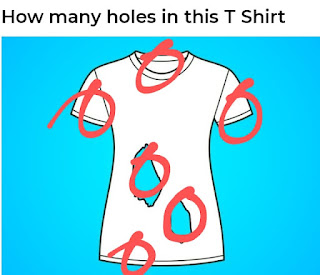
ANSWERS TO BRAIN TEASERS Try to solve these Optical Illusions, Puzzles, and Brain teasers to increase your IQ level. It will help you to solve the Quizzes for any Competitive Exams. Prof. Masood Sadiq Answer: 1 Eight total holes in the vest. Answer: 2 Only 3 can reverse to clear traffic. Answer: 3 The word 'SPOT' is written twice in the pic Answer: 4 Look at the open holes toward F Answer: 5 Look at the upper of the pond. Answer: 6 Look at the left arm of the woman under the curtain. Answer: 7 Look at the back side of the elephant just over the bushes. Answer: 8 Look at the leaves just at the bottom of the picture. Click here to watch more Logical Reasoning based questions Answer: 9 Look at the shadow of a palm tree and shadowless camels. Answer: 10 Look at the picture closely. Answer: 11 Three matchsticks are just behind the lighter and five are in reflections, so there are Eight matchsticks in total. Click here to see a Unique River in the ...
True Colour Reveals Your Personality Every colour has its unique impact on your personality. This short analysis will reveal some very interesting traits of your personality. It will help you to assess and make some amendments regarding your attitude to build strong relationships with others. Let's have one by one to view insight into your personality. The Color that showcases personality traits that seem more like you reveals your dominant colour. The True Colors Personality Test was created by Don Lowry in 1978 as a personality profiling system. No. 1 Orange Color Personality Traits If you like the Orange colour , your personality traits reveal you are quick, spontaneous, energetic, action-oriented, a risk-taker, competitive, and adventurous. You like to move out of your comfort zone sometimes. You are quick to spot opportunities and turn them into success. You like living in the moment. You like to move in a flexible time schedule. You are optimistic and have high l...




10/10 ✨🤗🥳
ReplyDelete